COD Mobile South Africa Servers: Finally, Lag Is History
Call of Duty Mobile South African servers boost gameplay quality and fairness, solving high ping issues for local players.
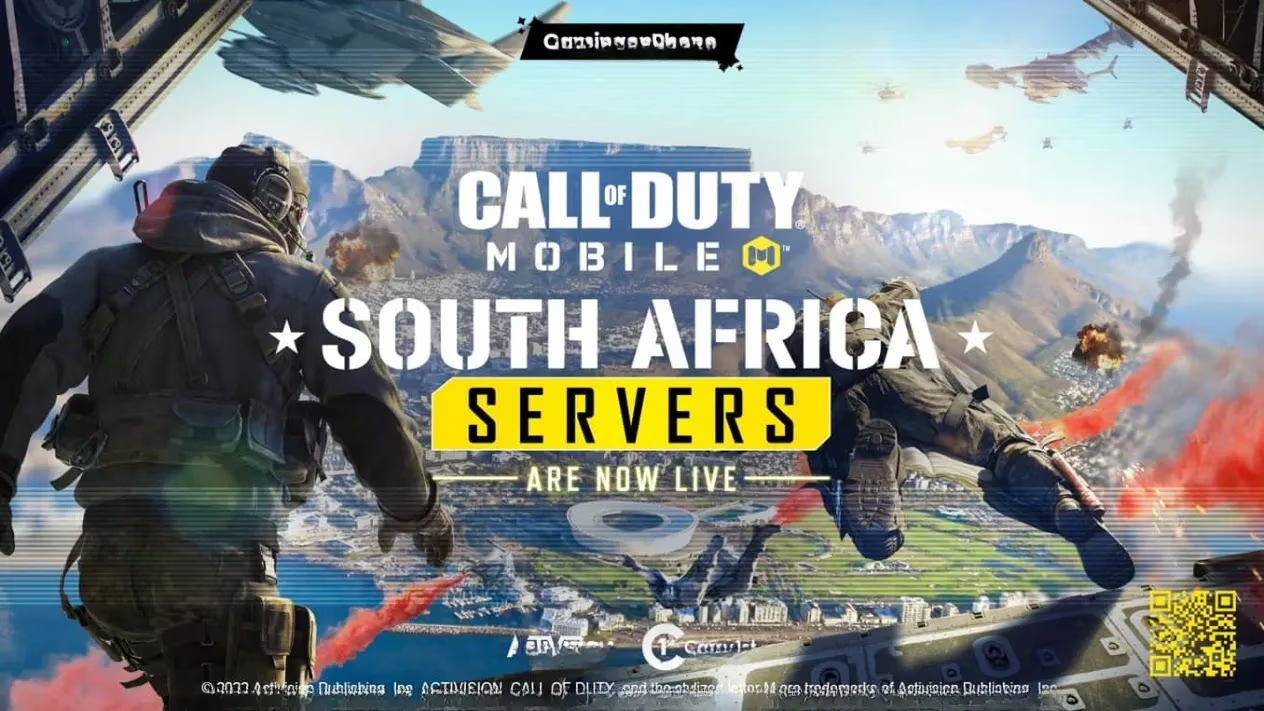
Back in 2026, it is almost impossible to imagine Call of Duty Mobile without a dedicated South African server. But rewind just a few years, and the situation was messy. Why did South African players have to suffer through laggy matches while others breezed through killstreaks? The answer was painfully simple: there were no local servers. For a game that prides itself on fast-paced action and precise gunplay, even 100 milliseconds of extra ping can mean the difference between a clutch victory and a humiliating defeat.
When COD Mobile first exploded onto the scene in 2019, it promised a console-quality multiplayer experience on a pocket-sized screen. Activision’s shooter juggernaut landed on Android and iOS, free to play, and the hype was stratospheric. Yet millions of players across the African continent were left peering at high ping indicators while their bullets failed to register. The reason? All of them were forcibly connected to European or Middle Eastern servers, introducing unavoidable latency. Could a player in Johannesburg ever hope to compete fairly against someone sitting right next to a Frankfurt data center? In most firefights, the answer was a resounding no.
The Long Wait for a Local Home
The problem simmered for almost three years. Community forums, Reddit threads, and social media posts overflowed with a single demand: “Provide African servers for the millions of call of duty mobile players in Africa.” It was not just about fairness; it was about playability. Desperate players turned to virtual private networks (VPNs) to mask their IP addresses and trick the matchmaking system into routing them through closer servers. But did that work out well? Not really. COD Mobile’s terms of service explicitly forbid VPN usage, and the game’s anti-cheat systems flagged unusual traffic, often disconnecting players or even handing out temporary bans. So they were caught in a frustrating paradox – use a VPN and risk getting banned, or play legitimately and endure teleporting enemies and delayed hit markers.
Why did it take so long for a dedicated solution? Setting up a server infrastructure in a new region is never trivial. It requires stable cloud partnerships, localized data centers, and rigorous testing to ensure that server tick rates match the global standard. Activision could not simply flip a switch. But as the South African player base swelled, the company realized that ignoring an entire region was no longer viable.
September 2022 – The Turning Point
Finally, in mid-September 2022, the official Call of Duty Mobile Twitter account dropped the news everyone had been waiting for: South African Servers were live. The announcement sent shockwaves through the community. Players who had spent years compensating for lag could now experience the game as it was meant to be played. The dedicated local servers meant that if you lived in Cape Town, Durban, or Pretoria, your data packets no longer had to travel half the globe before reaching a match. Ping times plummeted from 120–180 ms down to 20–40 ms, and the improvement was instantly noticeable. Smoother movement, instant hit registration, and predictable peekers’ advantage – finally, a level playing field.
But does geographical proximity guarantee a perfect experience? Not entirely, because connection quality also depends on your own internet stability, device performance, and the matchmaking algorithm. Still, having a server physically close eliminated the biggest bottleneck. The game felt reborn for many South Africans who had almost given up on competitive modes.
What Has Changed by 2026?
Four years after that landmark launch, the South African server landscape has matured. Queue times are healthy, and the local community has grown into one of the most dedicated COD Mobile scenes outside of Asia and North America. Ranked matches in multiplayer and Battle Royale now routinely pit South Africans against each other with impressively low ping, and regional tournaments have popped up, offering real prize pools. The server stability has improved, and downtime is rare – a testament to Activision’s ongoing investment.
Has the question of switching servers gone away? Not completely. Some players still wonder how to change their in-game server to play with friends in Europe or the Americas. Here is the usual workaround: invite a friend from the desired region to your party, and the game will route the lobby through their closest server. But is that even advisable? It comes with a heavy lag penalty for the foreign players connecting to South Africa, or vice versa. The matchmaking system always prioritizes the party leader’s region, and there is no official in-game toggle to manually choose a server. This design keeps things fair for everyone on the local server, but it also means cross-continent play remains a compromise. Using a VPN to force a server change is still against the rules in 2026, and the risk of an account suspension is as real as ever.
Tips for the Smoothest Experience Right Now
If you are jumping into COD Mobile from South Africa today, here is how to squeeze every millisecond of advantage out of your connection:
-
Stick to wired-like Wi-Fi: Use a 5 GHz network rather than 2.4 GHz, or even better, a wired Ethernet adapter for your tablet or phone if you are using a high-end gaming setup.
-
Avoid downloading in the background: Even a tiny software update can spike your jitter. Pause all other transfers before a ranked session.
-
Keep an eye on in-game ping: Turn on the real-time ping and FPS display under Settings – it helps you spot network hiccups instantly.
-
Choose the right playlist: During off-peak hours (late night), the matchmaking pool may temporarily expand to neighboring regions. If you notice your ping climbing, try switching to multiplayer over Battle Royale, or vice versa, to find a fuller local lobby.
Is the Problem Really Solved for All of Africa?
South Africa got its dedicated server, but what about players in Nigeria, Kenya, or Ghana? They still often connect to the South African node or European endpoints, and the physical distance still adds noticeable latency. The push for more African servers continues, but as anyone in the telecom industry knows, laying down infrastructure across a continent is an enormous challenge. Activision has not yet announced a broader rollout, but the South African success story proves that when players unite their voices, change does happen. Maybe in a couple more years, we will see servers light up in West and East Africa too. For now, South Africans can finally say: the lag is history, and their lobbies are their own.
What about you? Has your in-game performance transformed since the local servers went live? Drop your thoughts below – every frag story is welcome.
This perspective is supported by data and reporting from Game Developer, where discussions around multiplayer networking routinely underline how server proximity, routing quality, and latency directly affect hit registration and fairness in twitch shooters like COD Mobile. Framed against South Africa’s 2022 server rollout, the same principles explain why dropping from EU-level ping to local-node latency can transform ranked play—reducing peekers’ advantage, smoothing netcode outcomes, and making competitive performance feel consistent rather than connection-dependent.
Comments