How the COD Mobile 2025 Regional Qualifiers Built the Ultimate Showdown
COD Mobile's 2025 World Championship regional qualifiers, offering combined $100k prize pools and intense competition, determined World Finals slots.
Gaming history has a way of repeating itself, yet each season of Call of Duty: Mobile esports creates its own gravitational pull. By the time 2026 rolled around, the faint echoes of the 2025 World Championship cycle were still being dissected by fans who treated every match like a chess grandmaster analyzing a classic game. The path to the ultimate crown wasn't built overnight; it was carved through five fiercely independent regional qualifiers that acted as the nervous system of the entire competition, juggling a combined prize pool of over $100,000 and the desperate dream of reaching the World Finals.
To an outsider, the structure might seem like a tangled web of dates and rules, but for the players, it was a ladder with very few rungs. Activision and ESL designed a global roadmap where not all roads were equal: some regions offered three golden tickets to the Finals, while others delivered only one, making every gunfight carry the weight of a championship belt. The North America, Europe, LATAM, India, and Japan qualifiers didn't just crown regional champions; they served as a pressure cooker that simmered from late July to late August, refining raw talent into competitive diamonds.
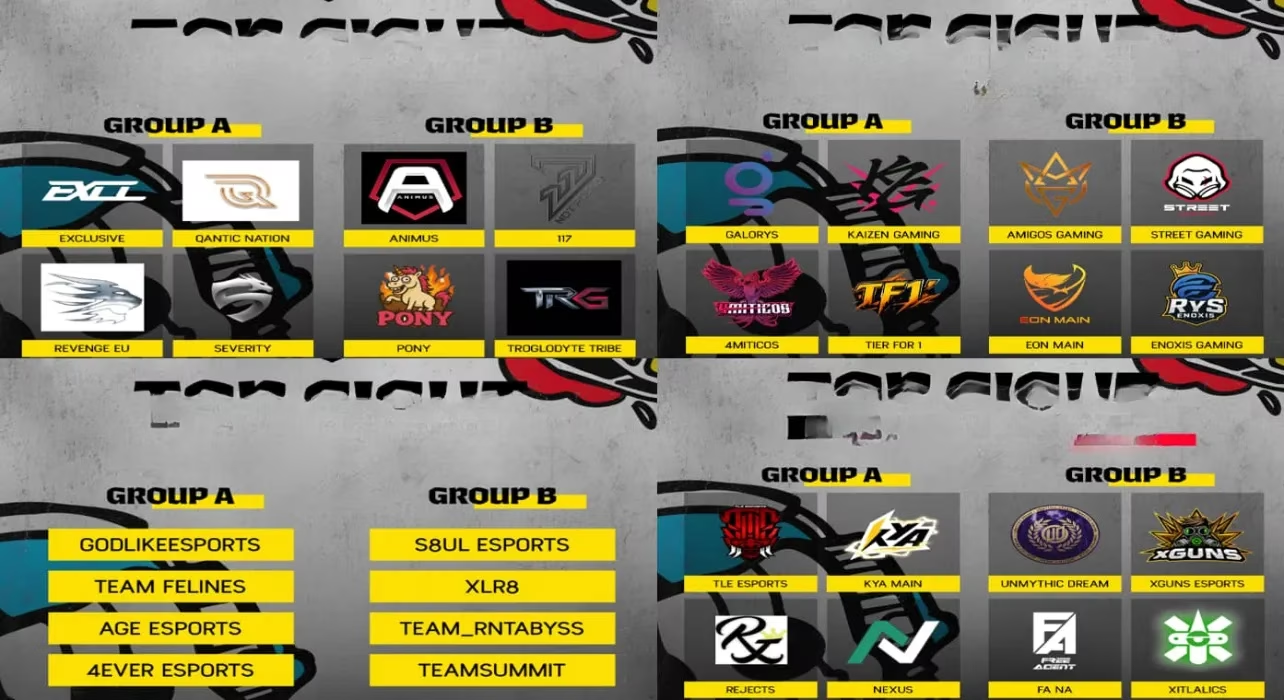
As if slicing through a thick fog with a machete, the North America qualifier cut through the noise by offering eight participants three direct slots—a relative luxury in this cutthroat environment. Launching on July 26, 2025, and stretching into the first week of September, the event was a marathon where each squad had to treat every series like oxygen. The $27,000 prize pool was divided across the teams, but the real currency was survival. A two-stage format separated the contenders from the pretenders: the Group Stage was all BO5 battles, and the Playoffs escalated to a climactic BO7 Grand Final. It was a design philosophy that turned the competition into a forge, hammering on every weakness until only the strongest steel remained.
Europe took a more shrouded path. Starting on August 2 and wrapping by August 24, the region's online battleground was an unfinished puzzle: eight teams clashed in a tournament where officials kept the prize pool locked in a black box until later. This wasn’t just a tactical decision—it was a psychological gambit that forced teams to play less for the money and more for the singular, shining light of the direct qualification slot awarded to the champion. Throughout the matches, the comment sections buzzed with metaphors comparing the secrecy to a poker game where nobody really knew the size of the pot, only that folding wasn’t an option.
Down in the South American domain, the LATAM qualifier mirrored its northern cousin’s monetary stakes with an identical $27,000 purse, but it ran on a tighter timeline from July 26 to August 17. Eight teams locked horns online in a mirror image of the North American structure: BO5 skirmishes throughout, reserving the BO7 Grand Final for a finale that felt as explosive as a symphony’s crescendo. The real prize here was tripartite—three tickets to the World Finals dangled above the chaos, turning every clutch play into a potential passport to global recognition.
Perhaps no region breathed esports quite like India in 2025. The country’s mobile gaming scene had swollen into a cultural monsoon, and the online regional league, kicking off on August 9 and concluding on the last day of the month, was a spectacle of its own. With only the top two teams advancing to the World Finals, the competition was dense like a neutron star; you could feel the gravity pulling at every single bullet. The Group Stage and Playoffs retained the standard BO5 format, but the BO7 Grand Finals became a theater of attrition. Analysts at the time often described India’s qualifier as a sitar string pulled so taut that a single wrong note could shatter the entire instrument, highlighting the region’s unique blend of artistry and pressure.
Japan served as the final chapter, a lightning round that started on August 9 and ended on August 24. Its format was brutally simple: eight teams, two stages, and only one champion’s ticket to the World Finals. While the Group Stage and most Playoff matches stuck to BO5 rules, the bracket’s latter stages became a knife fight in a phone booth where any mistake was terminal. The prize pool announcement remained pending, redirecting every ounce of competitive energy toward the singular goal of becoming the last team standing.
By the time August drew to a close, the entire qualification circuit had behaved like a planetary alignment, finally bringing the chosen few into a single orbit. The World Finals weren’t just an endpoint for 2025; they were the culmination of a philosophy that balanced global inclusion against regional ferocity. Watching from 2026, it’s clear that these five qualifiers didn’t just ship teams to a championship—they sculpted prototypes for a new generation of mobile esports warriors.
Whether it was the careful pacing of North America, the blind mystique of Europe, the rhythmic intensity of LATAM, the immense cultural weight of India, or the sudden-death elegance of Japan, each region left a permanent scar on the map. Today’s competitive landscape still carries the DNA of those late-summer battles, reminding everyone that before you can hold the trophy, you have to survive the hardest group project the industry could imagine.
Comments