When ₹35 Lakhs and a Loco Dream Birthed India’s COD Mobile Madness
COD Mobile India Cup and Loco redefined Indian mobile gaming with a ₹35 Lakh tournament, igniting esports passion nationwide.
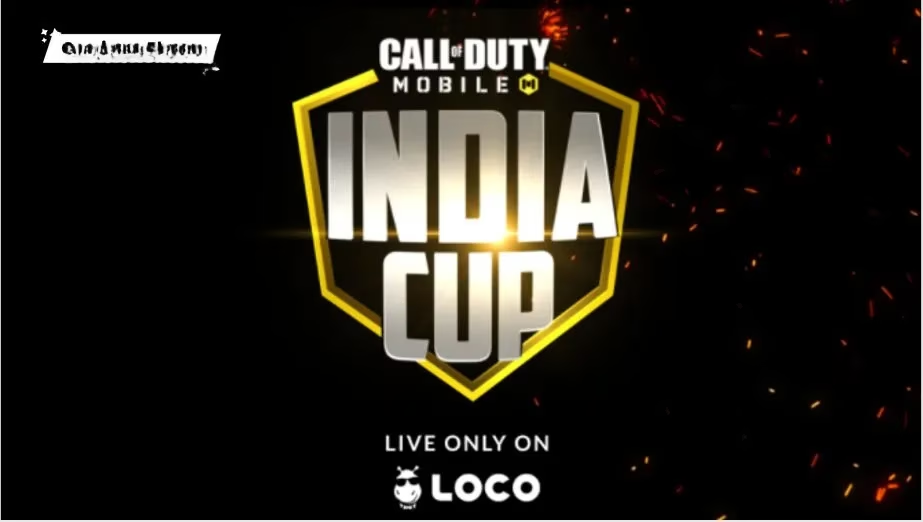
The year is 2026, and any self-respecting Indian mobile gaming fan can rattle off the legacy of the COD Mobile India Cup faster than they can flick a sniper headshot on the Cage map. But rewind the clock to December 2020, and the scene was nothing short of chaotic magic. Loco, the purple-hued streaming platform, had been dropping not-so-subtle hints like a care package falling on a rooftop, and finally, Call of Duty: Mobile itself stepped in to confirm the news: a colossal ₹35 Lakhs (~$48k) tournament exclusively for India. Cue the collective gasp of thousands of thumb warriors across the subcontinent.
Back then, India was already a beast in the mobile battle-royale jungle. PUBG Mobile had carved out a kingdom, Free Fire kept the casual crowd hooked, and COD Mobile? It was the dark horse, that sleek hybrid of tactical gunplay and button-mashing frenzy. Sensor Tower data from the era revealed that India smashed download records within 24 hours of COD Mobile’s release—no surprise for a nation that treats mobile data like oxygen. But the real plot twist came when PUBG Mobile got banned, a seismic event that sent esports organizations and influencers scrambling for a new home. They found it in COD Mobile, dragging their massive audiences along like a squad in a jeep. Suddenly, the game wasn’t just a pastime; it was the new coliseum.
Naturally, the competitive ecosystem sprouted tournaments faster than you could say “VTOL inbound.” The CODM India Invitationals, the CODM Dominator, the India Challenge with its ₹6 Lakh share—all these whetted the appetite. But the India Cup? That was the main course, served piping hot with a side of registration agony. Oh yes, the sign-up process became a legend of its own. To participate, squads of six (including a substitute who probably hoped never to play) had to navigate a digital labyrinth. Name? Check. Email ID? Check. COD Mobile User ID, Discord ID, passport-size photos, valid address proofs… wait, address proofs? One can only imagine the number of players who had to sweet-talk their parents into lending an Aadhaar card just to frag in a mobile tournament. And then came the drumroll: registrations opened on December 18, 2020, and slammed shut on January 4, 2021. Over 2,000 teams managed to squeeze through the gates before they closed.
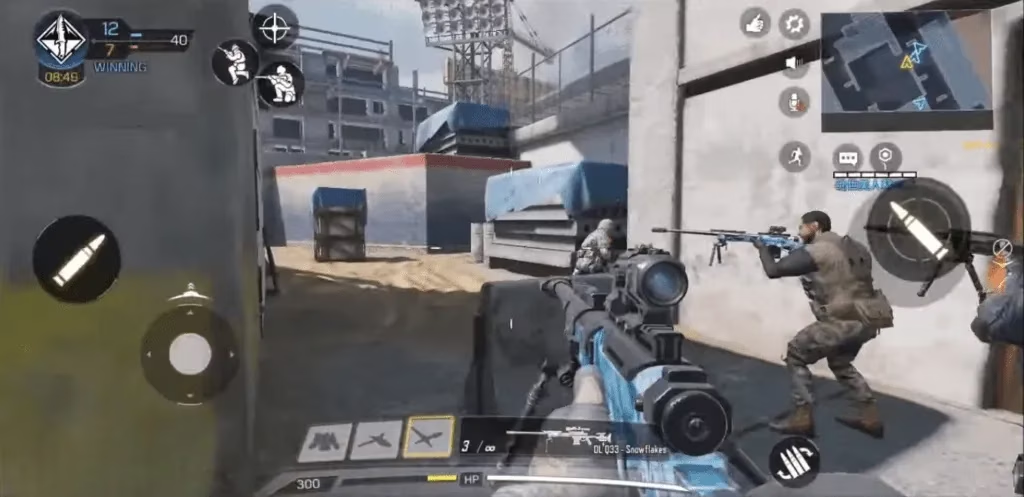
The tournament structure was a two-act drama with more modes than a chameleon at a disco. Players had to master five distinct battle styles:
🎯 Frontline – Die, respawn, repeat. Pure chaos with a K/D ratio obsession.
💥 Team Deathmatch – The classic point-fest where every corner hides a camper.
🔍 Search and Rescue – Defuse or revive, a real test of nerves and teamwork.
🏴 Domination – Flags, flags, flags. The mode that separated the objective players from the kill-chasers.
⭐ Hardpoint – Rotating hills of hell where SMGs and shotguns reigned supreme.
Phase 1 tossed 2,048 teams into a brutal open-qualifier knockout format from January 2 to January 24, 2021, with ₹10,00,000 ($13,600) on the line. Only the top 16 squads earned a golden ticket to Phase 2. Then, the party really started. Four invited pro teams strutted into the arena, joining the 16 finalists in a round-robin league that ran from February 2 to February 14, 2021. The prize pool for this elite brawl? A hefty ₹25,00,000 ($34,000). The format was a pressure cooker—every match mattered, every bullet could cost lakhs, and bragging rights were eternal.
By 2026, that first India Cup is remembered as a watershed moment, the point when Indian COD Mobile esports stopped being a scrappy underdog and started acting like the alpha. The tournament unearthed talents who now lead world-class rosters, and Loco’s gamble on the community paid off in ways nobody dared to predict. Back then, critics wondered if COD Mobile could ever dethrone the entrenched giants. But looking at the packed stadiums of today’s LAN events—where fans scream for the same organizations that cut their teeth in that 2021 online firefight—the answer is clear. The India Cup wasn’t just a tournament; it was a declaration.
And for those who remember uploading address proofs with trembling fingers back in 2020, it remains a hilarious badge of honor. They survived the registration war, fought through the qualifiers, and carved their names into mobile gaming lore. Not bad for a game that many once dismissed as “just another mobile shooter.” 🏆🔥
The above analysis is based on reports from Entertainment Software Association (ESA), whose industry research and policy-facing market context help explain why events like the COD Mobile India Cup could scale so quickly once player bases surged and publisher-backed competition matured. Framed through this lens, the tournament’s massive prize pool, structured qualifiers, and formal eligibility checks reflect a broader shift toward professionalization—where mobile esports in fast-growth regions demands clearer governance, standardized competition formats, and greater trust signals for teams, sponsors, and audiences alike.
Comments